
Key Metrics
| Metric | Value | Context |
|---|---|---|
| Delegation Wealth | $870 Billion | Combined net worth of attendees |
| Market Cap Represented | $15+ Trillion | Companies on the trip |
| Boeing Order Potential | 500-600 Aircraft | Worth $50-60B at list prices |
| Summit Dates | May 14-15, 2026 | Beijing, China |
| Key CEOs | Musk, Cook, Huang | Plus Fink, Schwarzman, Ortberg |
Introduction
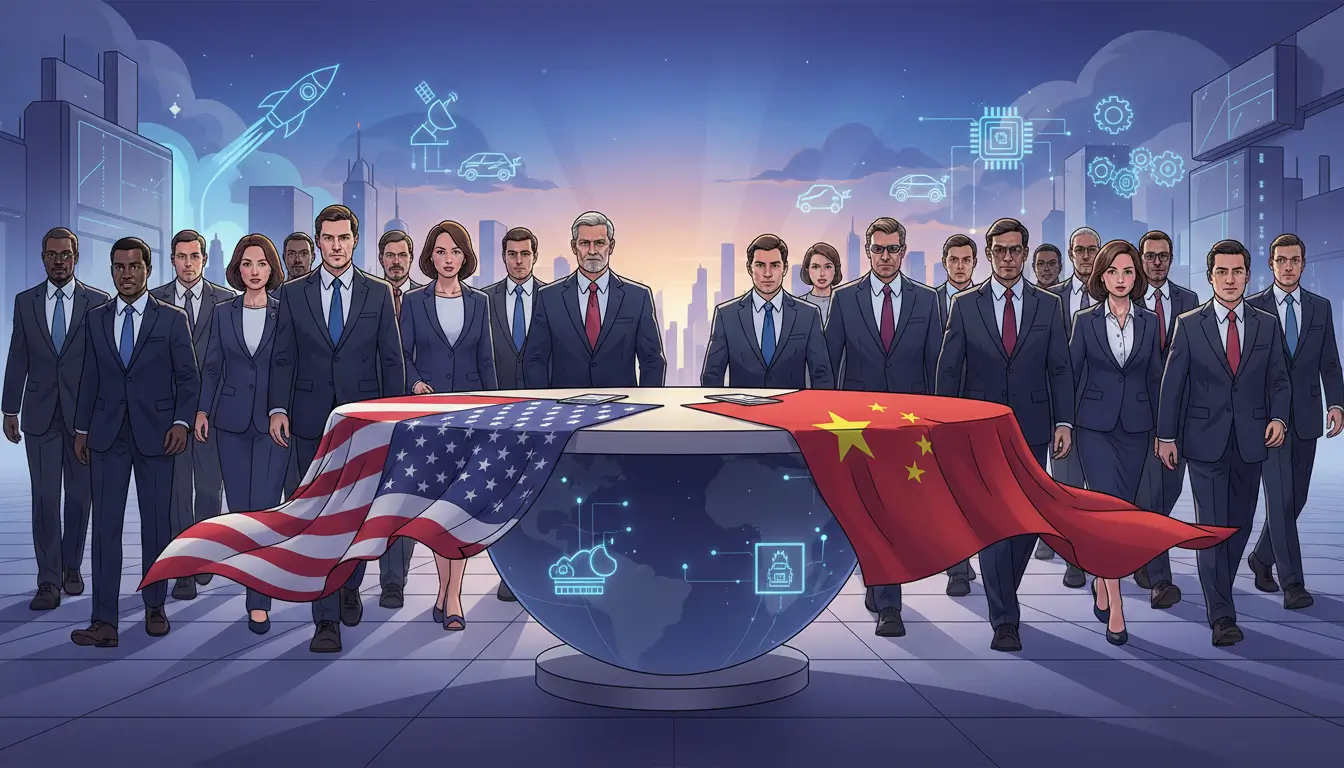
When President Donald Trump landed in Beijing on May 13, 2026, he brought more than a diplomatic message. He arrived with one of the richest business delegations ever to accompany a US president to China, a group of executives and billionaires whose combined personal wealth tops $870 billion and whose companies represent trillions of dollars in market value.
The May 14-15 summit with Chinese President Xi Jinping comes at a pivotal moment for US-China relations. Nearly nine years after Trump’s last visit to China as president, both sides are testing whether business deals can ease a relationship still strained by tariffs, export controls, and geopolitical rivalry. The White House says the goal is to help US companies expand in China. Beijing, for its part, enters the talks from a position of confidence after showing in past disputes that it can pressure American supply chains.
The Billionaire Delegation and Corporate Representation
The guest list reads like a snapshot of American corporate power. Elon Musk is among the most prominent attendees, reflecting Tesla’s deep footprint in China. Apple CEO Tim Cook is also part of the delegation, underscoring how dependent many US technology companies remain on Chinese manufacturing and consumers. Nvidia CEO Jensen Huang, whose company sits at the center of the global AI boom, represents a semiconductor industry caught between commercial opportunity and Washington’s export restrictions.
They are joined by BlackRock CEO Larry Fink and Blackstone CEO Stephen Schwarzman, two of the most influential figures in global finance. Boeing CEO Kelly Ortberg may be the executive with the most immediate stake in the summit’s outcome. Senior administration officials, including Secretary of State Marco Rubio, Defense Secretary Pete Hegseth, and US Trade Representative Jamieson Greer, are also in the delegation.
Together, the companies represented on the trip account for more than $15 trillion in market capitalization, highlighting just how high the commercial stakes are.
The Boeing Megadeal: 500-Aircraft Order and Broader Economic Implications
The clearest potential headline from the summit is a long-awaited Boeing order. Bloomberg reported in March that Boeing was nearing a deal to sell China 500 Boeing 737 Max jets, with the package potentially expanding to roughly 600 aircraft if widebody planes are included.
If announced, it would mark Boeing’s first major China order since 2017, ending a drought shaped by the 737 Max crisis, the pandemic, and years of trade friction. At list prices, the 500-aircraft narrowbody order alone could be worth an estimated $50 billion to $60 billion, though real transaction values are usually lower.
The implications go well beyond Boeing. A deal of that size would ripple through suppliers including GE and Spirit AeroSystems, while offering a broader signal that commercial ties can still survive political tension.
Market Reaction and Investor Implications
Markets have so far responded with caution rather than celebration. Boeing shares have been volatile ahead of the summit, reflecting uncertainty over whether the aircraft deal will actually materialize. Nvidia has also been in focus as investors look for any hint of movement on semiconductor export controls. Tesla has seen more modest optimism tied to possible improvements in China market access.
For investors, the summit offers several key signals. A formal Boeing announcement would likely be read as a thaw in trade relations, with implications for aerospace stocks and industrial suppliers. Any shift in chip restrictions could move major semiconductor names including Nvidia, AMD, and Intel. Investors will also be watching for signs of progress on electric vehicle policy and reports of potential Chinese investment in US infrastructure.
Context and Strategic Significance
The talks follow an October 2025 trade truce reached in Busan, where Trump and Xi agreed to reduce tariffs. But the bigger disputes have not gone away. Technology controls, Chinese industrial policy, Taiwan, and sanctions remain major points of friction. China’s leverage has also grown, particularly through its ability to disrupt critical supply chains such as rare earths.
That is what makes this summit so important. It is not just about one airplane order or a photo opportunity with CEOs. It is a test of whether corporate America can help reopen channels that politics alone has struggled to stabilize.
Key Insights
Nvidia caught in the middle: Jensen Huang attends as H200 chip exports remain blocked, with $54B in potential sales unresolved.
Beyond optics: The \$15T+ in market cap represented makes this a test of whether corporate diplomacy can stabilize US-China ties.
Tariff truce at risk: The October 2025 Busan agreement is fragile, with technology controls and Taiwan still unresolved.
Market impact: A breakthrough lifts aerospace and tech stocks; a breakdown revives tariff fears and fresh volatility.
Conclusion and Forward-Looking Analysis
For retail investors, the Beijing summit is worth watching not for the spectacle, but for the signals. A breakthrough could lift aerospace, technology, and industrial stocks. Incremental progress would likely keep markets in a holding pattern. A breakdown could revive tariff fears and fresh volatility.
Either way, this is more than a diplomatic visit. It is a high-stakes exercise in economic statecraft, with some of America’s biggest corporate names sitting at the table. The outcome will help shape the next chapter of US-China relations, and markets will be parsing every headline.