
Key Insights
FSD v13.0 achieves Level 4 autonomyNew end-to-end neural network with OmniVISION architecture reaches Level 4 in San Francisco, LA and Austin.
99.998% reliability in standard driving1.2 million test miles without disengagement, 20x processing efficiency improvement.
FSD revenue target raised to $8-10B by 2028Up from prior $3-5B forecast, driven by subscriptions, licensing and ride-hailing.
Three automaker licensing deals signedTesla expects several hundred million dollars from licensing partners starting in 2027.
Key Metrics
| Metric | Value | Context |
|---|---|---|
| Share Price Jump | +8% | $235.40 to $254.23 after-hours |
| Market Cap Added | $60 Billion | Single-day gain |
| Q1 2026 Revenue | $38.5 Billion | +12% YoY |
| Gross Margin | 18.2% | Up from 16.8% prior quarter |
| FSD Revenue Target (2028) | $8-10 Billion | Up from $3-5B prior forecast |
| Test Miles (No Disengage) | 1.2 Million | Across SF, LA, Austin |
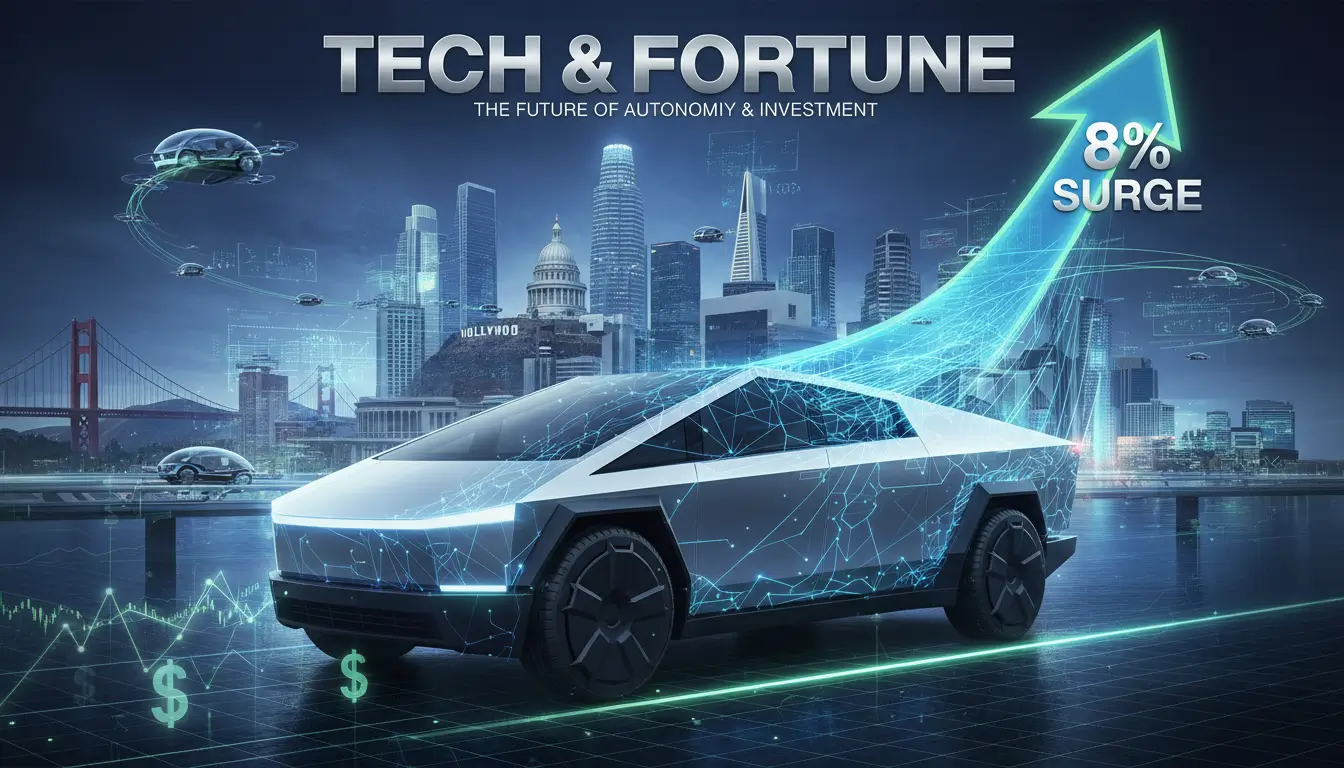
Tesla Shares Surge 8% Following Unveiling of New AI-Driven Self-Driving Tech in Latest Earnings Call
Tesla gave investors something they had been waiting to hear: a fresh reason to believe its autonomous-driving story again.
Shares of the electric-vehicle maker jumped about 8% in after-hours trading on May 2, 2026, after CEO Elon Musk used the company’s first-quarter earnings call to unveil major updates to Tesla’s AI-driven self-driving technology. The rally, which lifted the stock from roughly $235.40 to $254.23, added about $60 billion to Tesla’s market value and marked one of its biggest single-day gains this year.
The move was especially notable because it came after months of muted trading and lingering doubts about Tesla’s autonomous roadmap, even as AI remained one of Wall Street’s defining themes.
AI Technology Breakthrough Details
At the center of the excitement was Tesla’s new “FSD v13.0,” which the company described as its biggest leap in self-driving technology since launching the Full Self-Driving beta program in 2020.
Tesla said the new system uses an end-to-end neural network that converts visual data directly into driving commands, replacing the older step-by-step process of perception, planning and control. The company also introduced what it called “OmniVISION,” a unified vision architecture designed to process multiple sensor streams at once.
According to Tesla, the upgrade delivers a 20-fold improvement in processing efficiency, cutting latency from 100 milliseconds to about 5 milliseconds. The company also said the system achieved 99.998% reliability in standard driving scenarios, a tenfold improvement from the prior version.
Most striking was Tesla’s claim that the technology has reached Level 4 autonomy in geofenced urban areas including San Francisco, Los Angeles and Austin. Tesla said its test fleet logged 1.2 million miles in those cities without disengagement.
Financial Performance and Forward Guidance
Tesla’s quarterly numbers were solid, if not spectacular. First-quarter revenue rose 12% from a year earlier to $38.5 billion, slightly below analyst expectations of $39.2 billion. Automotive revenue totaled $33.2 billion, while energy generation and storage brought in $5.3 billion.
Profitability improved. Gross margin climbed to 18.2% from 16.8% in the prior quarter, helped by lower battery costs and better manufacturing efficiency. Net income came in at $3.8 billion, or $1.12 a share, topping estimates of $1.08. Tesla also reported $4.2 billion in operating cash flow, $2.9 billion in free cash flow and $42.3 billion in cash and equivalents.
What really grabbed the market, though, was Tesla’s updated outlook. The company said it now expects FSD to generate $8 billion to $10 billion in annual recurring revenue by 2028 through subscriptions, licensing and ride-hailing, well above its prior forecast of $3 billion to $5 billion.
Tesla also said it had signed licensing agreements with three major automakers, though it did not name them. Musk said those deals could bring in several hundred million dollars in 2027.
Market Context and Competitive Landscape
Tesla’s announcement lands at a pivotal moment for both AI stocks and the autonomous-vehicle industry. Investors have become more selective in 2026, rewarding companies that can turn AI ambition into measurable revenue and margin gains.
That is why Tesla’s message resonated. The company is no longer pitching autonomy as a distant promise alone; it is framing it as a business with recurring software revenue and licensing potential. Musk underscored Tesla’s scale advantage, saying the company has logged more than 100 billion miles of real-world driving data, far ahead of rivals.
Regulatory and Implementation Timeline
Execution remains the key question. Tesla plans a limited beta rollout to around 10,000 users in the third quarter of 2026, followed by a broader North American release for compatible vehicles in the first quarter of 2027.
The biggest hurdle is regulatory approval. Tesla said it has been in advanced discussions with the National Highway Traffic Safety Administration for several months and presented data showing the new system reduced accident rates by 94% versus human drivers in similar conditions.
Conclusion
Tesla’s latest earnings call did more than lift the stock. It reshaped the conversation around the company’s future.
For retail investors, the takeaway is clear: Tesla is still an automaker, but Wall Street is once again being asked to value it like a software and AI company. Whether that re-rating holds will depend on execution, regulation and whether the promised self-driving revenue actually arrives. For now, investors appear willing to give Tesla the benefit of the doubt.