
Key Insights
Only 3.75% of shares offered to publicTiny float reduces liquidity, amplifies volatility and limits index eligibility for S&P 500.
Starlink generates 58% of revenueInvestors are buying a satellite internet company, not a pure-play rocket business.
Musk controls all major decisionsPublic shareholders get economic exposure with near-zero governance power.
$75B raise dwarfs Saudi AramcoNearly 3x the largest IPO in history, raising questions about who benefits most.
Key Metrics
| Metric | Value | Context |
|---|---|---|
| Target Valuation | $1.75T - $2T | 129x projected 2025 revenue |
| Public Float | 3.75% | Unusually small for an IPO of this size |
| Capital Raised | $75 Billion | Nearly 3x Saudi Aramco IPO |
| Starlink Revenue (2025 est.) | $11.8 Billion | 58% of total revenue |
| Revenue Multiple | 129x | vs Tesla 6x, Boeing 1.5x |
| NASA Revenue Share (2026) | ~5% | Down from historical levels |
SpaceX IPO: Elon Musk's Biggest Heist? Why This Record-Breaking Offering Could Be a Catastrophic Loss for Retail Investors
Introduction: History in the Making or History Repeating?
Few potential IPOs have generated as much anticipation as SpaceX. Elon Musk’s private space company is reportedly preparing for what could become the largest initial public offering in history, seeking to raise $75 billion at a valuation of roughly $1.75 trillion to $2 trillion. For retail investors, the pitch is irresistible at first glance: a chance to buy into the company behind reusable rockets, satellite internet, and the broader commercialization of space.
That story is powerful. It is also exactly what makes this offering so potentially dangerous.
SpaceX is not just another highly valued tech company coming to market. It is a business wrapped in ambition, celebrity, and a future-facing narrative that can easily overwhelm sober analysis. And while the company’s technological accomplishments are real, the terms of the proposed IPO, the valuation being discussed, and Musk’s approach to corporate control all raise serious questions.
For everyday investors, this may look like a once-in-a-generation opportunity. It may also be a textbook case of peak hype meeting extreme pricing. Before buying into the dream, investors should take a much harder look at what exactly they would be getting,and what they would be risking.
The Unprecedented Scale: Breaking All Records
By any measure, the proposed SpaceX offering would be enormous. A $75 billion raise would dwarf past blockbuster IPOs. Saudi Aramco’s 2019 listing, still the global benchmark, raised $25.6 billion. SpaceX is aiming for nearly three times that amount.
That alone would make the deal historic. But the size of the raise is only part of the story.
SpaceX reportedly plans to sell just 3.75% of the company to public investors. That is an unusually small float for a listing of this magnitude, and it has important implications. A public offering this limited can reduce liquidity, amplify price swings, and restrict the stock’s eligibility for major market indices such as the S&P 500 or Nasdaq-100. If index inclusion is off the table, one key source of institutional demand may be weaker than many investors expect.
The company’s revenue projections also help explain why excitement is building so rapidly. Musk expects SpaceX to generate $15.5 billion in revenue in 2025, with only about $1.1 billion coming from NASA. Starlink, the company’s satellite internet business, is projected to contribute an estimated $11.8 billion on its own.
That shift matters. Investors may think they are buying a pure-play rocket company, but increasingly, the business appears to be centered on broadband connectivity from orbit. Space exploration may be the brand. Starlink may be the economic engine.
The Valuation Problem: Astronomical Numbers Meet Financial Realities
This is where the investment case becomes much harder to defend.
At a $2 trillion valuation, SpaceX would trade at roughly 129 times projected 2025 revenue. That is not merely aggressive. It is an extreme premium even by the standards of high-growth technology companies.
For context:
- Tesla currently trades at about 6 times revenue
- Boeing trades at roughly 1.5 times revenue
- SpaceX, at the proposed level, would be valued at approximately 129 times projected revenue
Valuation is never just about where a company is today. It is about what investors believe it can become. But when a stock is priced this richly, the market is no longer rewarding strong execution alone. It is pricing in near-perfect execution for years, possibly decades.
That leaves very little room for disappointment.
Any stumble,a slowdown in Starlink growth, launch delays, rising competition, margin pressure, regulatory setbacks, or broader market weakness,could force investors to reassess what they are willing to pay. And when expectations are this high, even small cracks can lead to large repricings.
SpaceX’s revenue mix also deserves closer attention. Starlink is expected to generate about 58% of total revenue in 2025, meaning the legacy rocket business accounts for less than half. That evolution may make strategic sense, but it creates a different risk profile than many investors associate with the company. This is no longer primarily a government-contract aerospace story. It is increasingly a commercial communications business with substantial concentration in one fast-growing but still vulnerable segment.
NASA, by Musk’s own account, is expected to represent only around 5% of revenue in 2026. Diversification away from government dependence sounds positive. But replacing relatively stable public-sector contracts with a business exposed to competition, regulation, and consumer demand introduces another layer of uncertainty.
The Musk Factor: A Track Record of Volatility
Any investment in SpaceX would also be, in part, an investment in Elon Musk’s leadership style.
That comes with clear upside in terms of vision and execution. It also comes with serious governance risks.
Leadership Concentration: Musk maintains control of SpaceX, which means public shareholders would have little influence over major decisions. Investors would be buying economic exposure, not meaningful control. For some, that may be acceptable. But it is important to be honest about what that means in practice: if Musk wants to move fast, change strategy, or make controversial public statements, outside shareholders are largely along for the ride.
Volatility Risk: Tesla investors have already seen how Musk’s public behavior can affect a stock. His social media activity, sudden strategic pivots, and unpredictable messaging have repeatedly fueled sharp price moves. There is little reason to assume SpaceX would be insulated from the same pattern.
Competition for Attention and Resources: Musk’s empire is sprawling,Tesla, X, SpaceX, Neuralink, and The Boring Company all compete for his time and focus. A headline-grabbing SpaceX IPO could also reshape investor attention across his broader ecosystem, potentially creating tension with Tesla and other ventures.
Unusual Offering Terms: A 3.75% float means relatively few shares would actually trade in the public market. That kind of scarcity can create sharp price dislocations. In practical terms, it can make the stock more vulnerable to momentum-driven swings and potentially easier for insiders and early investors to influence through supply constraints.
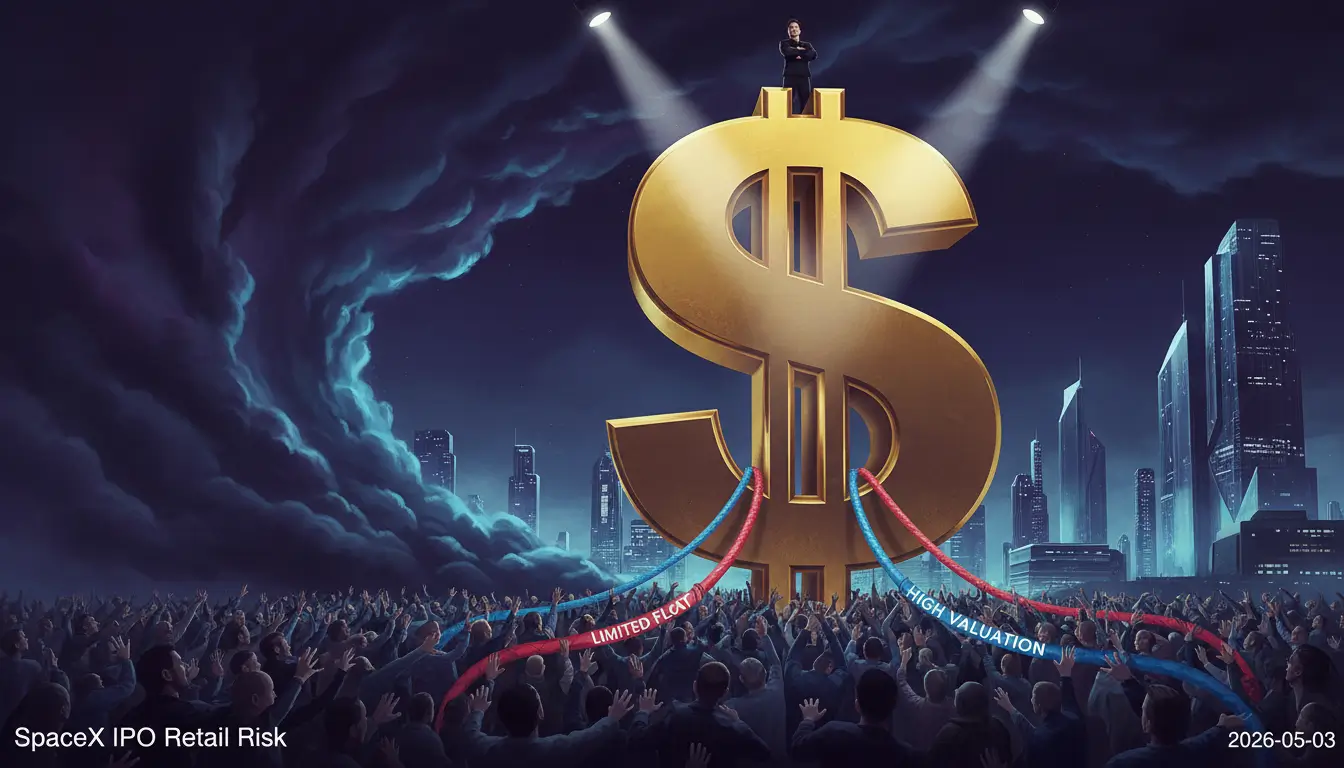
For retail investors, that combination,high valuation, limited float, and highly centralized leadership,is not a comforting setup. It is a formula for instability.
Three Critical Warning Signs for Retail Investors
1. Unprecedented Valuation Multiples
The biggest red flag is simple: the company appears to be priced for perfection.
At these levels, SpaceX would need to deliver extraordinary growth while fending off competition, navigating regulation, expanding infrastructure, and scaling multiple complex businesses. Investors would not just be betting on success. They would be betting on something close to flawless success.
That is a dangerous position from which to start.
2. Limited Information Access
SpaceX’s confidential filing process is legal and common for companies of its size, but it creates a practical disadvantage for retail investors. Institutions typically have more resources, more modeling capacity, and more opportunities to interpret management signals quickly once disclosures emerge.
Retail investors, by contrast, may be forced to make decisions on a compressed timeline with less context. In a deal as complicated and narrative-driven as this one, that information gap matters.
3. Potential Market Timing Concerns
Timing is another issue investors should not ignore.
The IPO is arriving in a market environment where interest rates remain elevated and enthusiasm for richly valued growth stories has proven inconsistent. That raises a fair question: is this a strategic public debut into long-term strength, or a chance for existing holders to monetize at what may be an unusually generous valuation?
Retail investors should always be wary when private insiders decide the public market is finally the right buyer.
The Starlink Question: Dominant but Vulnerable
Starlink is central to the bullish case for SpaceX. Its projected rise,from $1.4 billion in revenue in 2022 to an estimated $11.8 billion in 2025,is striking. If those numbers hold, the business will have become one of the fastest-growing and most important pieces of the SpaceX story.
But dominance today does not eliminate vulnerability tomorrow.
- Increasing Competition: Amazon’s Project Kuiper and other players are building competing satellite internet networks
- Regulatory Hurdles: Expansion depends on securing approvals across multiple jurisdictions, each with its own political and legal complications
- Technical Limitations: Bandwidth constraints and latency challenges remain especially relevant in densely populated regions
- Military Dependence: Some expected growth is tied to U.S. military demand, which can shift with budget priorities and politics
In other words, Starlink may be the crown jewel,but it is not a risk-free one. Investors paying premium multiples for that business should be realistic about the operational and policy headwinds still ahead.
Conclusion: Proceed with Extreme Caution
There is no question that SpaceX has transformed the space industry. It has lowered launch costs, changed expectations around reusable rockets, and built a satellite internet platform with global ambition. On the technology front, the company has already earned its place in business history.
That does not automatically make the IPO a good investment.
For retail investors, the gap between admiration and discipline matters. It is entirely possible for a great company to become a poor stock purchase if the price is too high, the structure too unfavorable, and the risks too asymmetric.
Key Takeaways:
1. Valuation Disconnect: A $1.75 trillion to $2 trillion valuation leaves little room for operational setbacks or slower growth
2. Limited Influence: Public investors would own only 3.75% of the company and have minimal governance power
3. Volatility Risk: A tiny float combined with Musk’s leadership style could produce sharp, unpredictable price swings
4. Alternative Exposure: Investors seeking access to the space economy may find more reasonably priced opportunities in established aerospace or satellite infrastructure companies
5. Wait for Financials: There may be merit in waiting for several quarters of public reporting before committing capital
The real danger with an IPO like this is not that the company lacks vision. It is that investors become so captivated by the vision that they stop asking hard questions about price, structure, and risk.
That is how retail investors get hurt.
If SpaceX goes public on the terms described, it may become one of the most talked-about offerings in market history. It may also become a case study in how excitement, scarcity, and celebrity can push valuation beyond what fundamentals can reasonably support. The biggest winners in that scenario are often not the people buying on day one. They are the insiders selling into the frenzy.