
Key Insights
Revenue growth accelerated to 20%+ for many suppliers in 2025, up from low double digits.
AI infrastructure is the biggest near-term catalyst, driving demand for optical interconnects in data centers.
Key listed players: Coherent, Lumentum, Fabrinet, Applied Materials.
ETF exposure: SOXX, XSD, FTXL include photonics component makers.
Key Metrics
| Metric | Value | Context |
|---|---|---|
| Photonics market (2025) | ~$900B | Projected $1.2T by 2030 |
| Industry revenue growth | 20%+ | Up from low double digits |
| Silicon photonics CAGR | 8-10% | Through 2030 |
| Key stocks | COHR, LITE, FN, AMAT | Data center optics leaders |
| ETF options | SOXX, XSD, FTXL | Broad photonics exposure |
| Valuation premium | Above tech sector | Pricing in AI demand |
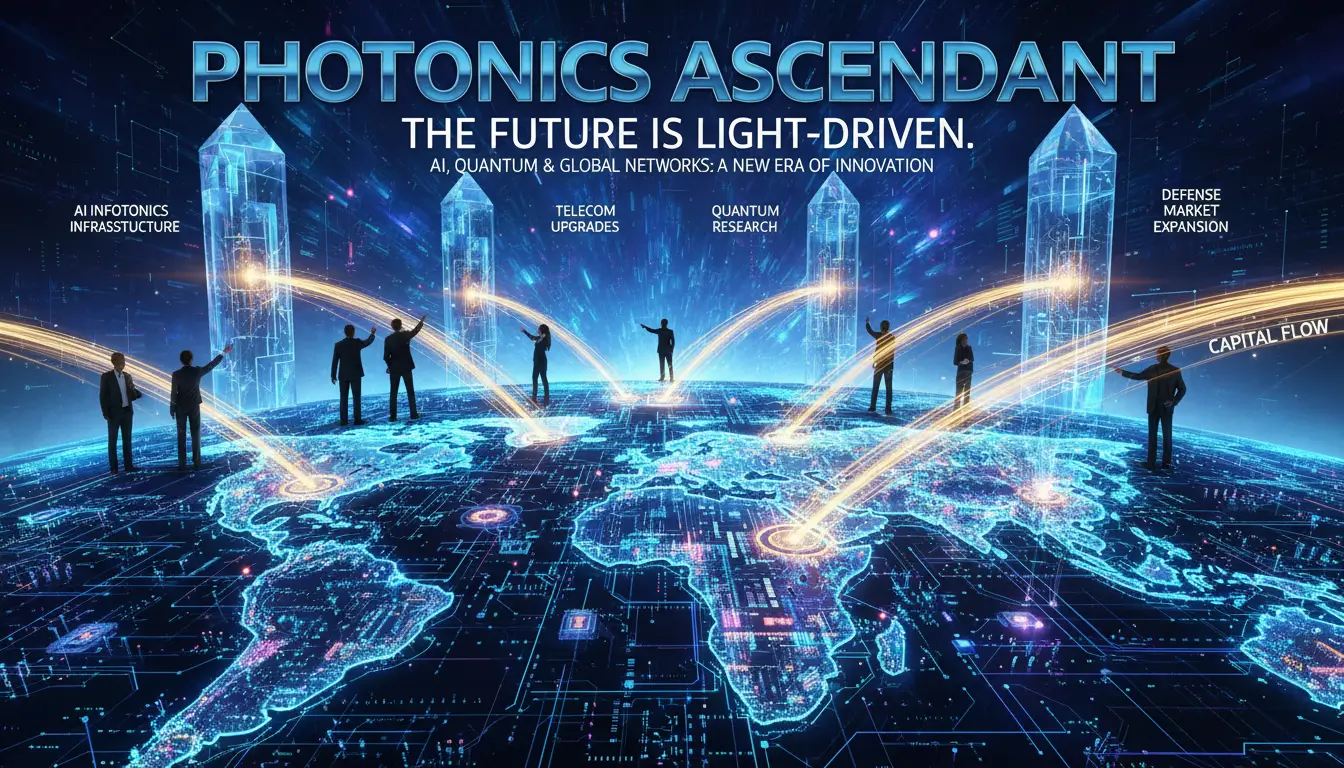
Photonics has moved from a specialist corner of tech into a central part of the global investment story. The market was worth about $900 billion in 2025 and is projected to reach roughly $1.2 trillion by 2030, implying annual growth of 8% to 10%. What has changed is not just scale, but timing: demand tied to artificial intelligence, telecom upgrades, quantum research and defense has pulled adoption forward by several years.
The biggest near-term catalyst is AI infrastructure. As data centers become more powerful, traditional electrical connections are struggling with speed, heat and power limits, pushing operators toward optical interconnects. Telecom is another steady source of demand as carriers expand fiber networks for 5G capacity and prepare for early 6G investment. Quantum computing remains a smaller market, but photonic control systems and optical components are becoming increasingly important. Defense spending is also rising, especially in sensors, LiDAR and other high-performance optical systems.
That demand is showing up in company results. Across the industry, revenue growth has accelerated sharply from low double digits a few years ago to well above 20% for many suppliers in 2025. Margins have improved as higher volumes and better manufacturing efficiency offset the heavy cost of expansion. In practical terms, photonics is no longer being treated as a cyclical niche tied mainly to telecom hardware. It is now embedded in some of the most heavily funded areas of the technology economy.
Public markets offer several ways to gain exposure, though the sector is uneven. Coherent and Lumentum remain among the best-known listed names, benefiting from demand in data center optics and communications equipment. Fabrinet has also stood out, helped by strong growth in optical manufacturing services. Applied Materials provides a broader semiconductor route with a photonics angle, while smaller and more specialized companies can offer faster growth but come with greater volatility and execution risk.
For investors who prefer diversification, semiconductor exchange-traded funds such as SOXX, XSD and FTXL include meaningful photonics exposure through optical component makers and related equipment suppliers. That route may be more attractive after a strong rally in individual names. Valuations across the group have expanded, with many photonics stocks now trading at a premium to the wider technology sector. The market is effectively pricing in sustained demand from AI networking, cloud buildouts and industrial applications.
That premium is not without risk. Supply chains for specialized materials remain tight, and geopolitical tensions could disrupt manufacturing or end-market demand. The sector also depends on continued capital spending from a relatively concentrated group of customers, especially hyperscale data center operators and telecom carriers. If those budgets slow, expectations could reset quickly.
Still, the long-term case remains intact. Optical technologies are becoming more important as computing systems process larger volumes of data and as networks require faster, more efficient transmission. The next phase for investors will be less about the broad photonics theme and more about execution: which companies can convert demand into durable margins, manage capacity expansion and hold their technological edge. That will likely determine who benefits most from a market that still appears to have years of growth ahead.