
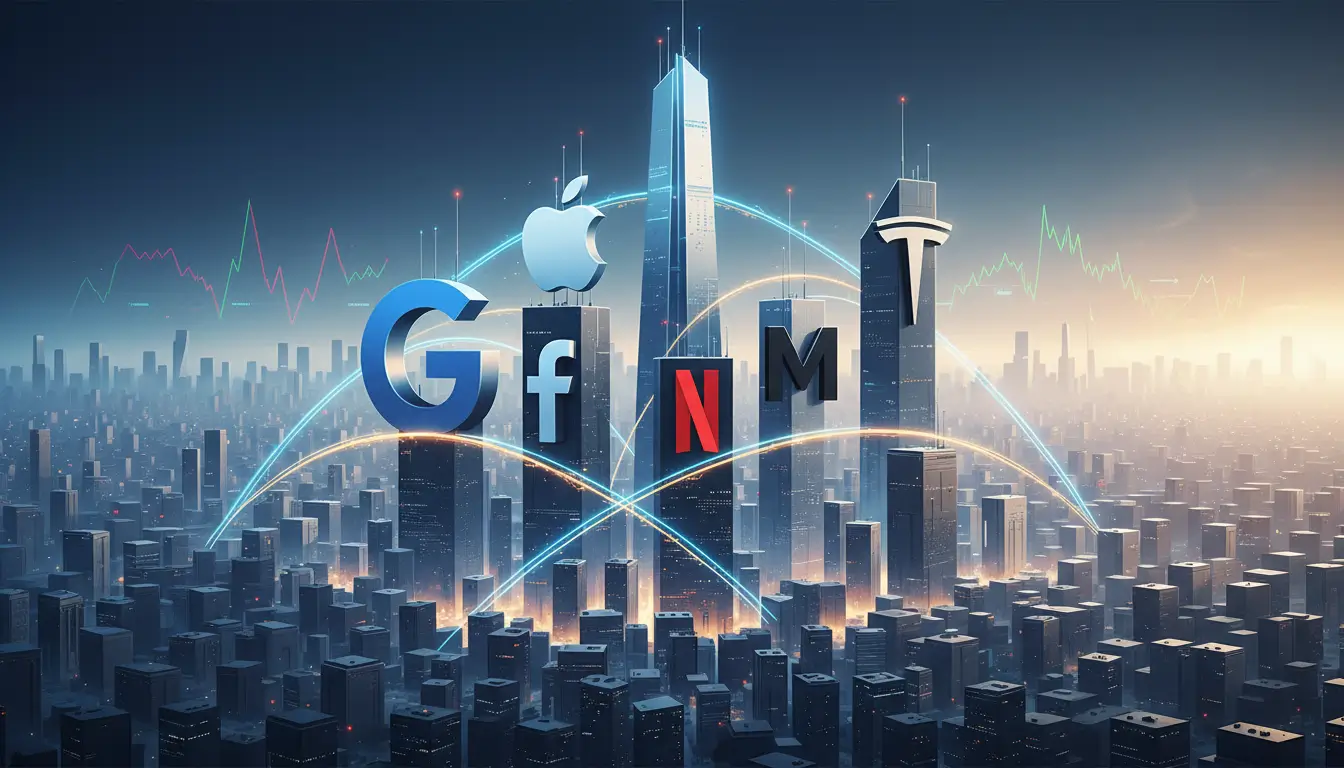
Key Insights
Concentration risk is real. The top 7 stocks make up 30%+ of the S&P 500, the highest concentration in decades.
Apple holds the largest market cap at over $3.5T, but growth has slowed to single digits.
AI spending fuels the group. Combined R&D exceeds $200B annually, more than most countries GDP.
Tesla is the wildcard, with the lowest margins and highest volatility among the seven.
Key Metrics
| Metric | Value | Context |
|---|---|---|
| Combined market cap | $18T+ | More than Japan GDP |
| S&P 500 concentration | 30%+ | Top 7 stocks |
| Nvidia market cap | $3.5T+ | Fastest to $3T ever |
| Apple market cap | $3.5T+ | Largest by market value |
| Combined annual R&D | $200B+ | More than most country GDPs |
| Avg PE ratio | ~35x | Premium to S&P 500 avg |
| Biggest laggard | Tesla | Lowest margins, highest beta |
As of May 9, 2026, the Magnificent Seven still sit at the center of the U.S. equity market, even after a bruising first quarter. Nvidia, Alphabet, Apple, Microsoft, Amazon, Meta Platforms and Tesla are worth more than $22 trillion combined, equal to about 33.7% of the S&P 500’s total market value as of mid-April. That is down modestly from last year’s peak near 35%, but it remains an extraordinary level of concentration for just seven stocks.
The group’s grip on the market has held up through a volatile stretch. Earlier this year, the stocks lost more than $2 trillion from their highs, including a sharp selloff in late March that wiped out $870 billion in a week. Yet the broader market has regained some footing. On May 9, the S&P 500 rose 0.84% to 7,398.93, while the Nasdaq gained 1.71% to 26,247.08, underscoring how quickly sentiment can turn when investors move back into large-cap technology.
There is still a clear pecking order within the group. Nvidia leads with a market value of roughly $4.8 trillion, supported by relentless demand for AI chips and data-center infrastructure. Alphabet follows at about $4.6 trillion after a strong run this year, while Apple stands near $4.1 trillion. Microsoft and Amazon remain close behind at roughly $3.1 trillion and $2.9 trillion, respectively. Meta, at about $1.68 trillion, has benefited from digital advertising resilience and its push into AI, while Tesla, at around $1.37 trillion, remains the smallest member but still commands outsized investor attention.
The common thread is earnings power. Analysts expect the Magnificent Seven to generate about $410 billion in first-quarter revenue, up 17% from a year earlier. For 2026, net income for the group is projected to rise about 25%, compared with roughly 11% for the rest of the S&P 500. That gap helps explain why investors continue to pay a premium for these companies even after the recent pullback.
Still, the pace of outperformance may be harder to sustain. Some Wall Street forecasts suggest the earnings advantage of the biggest tech names could narrow over the next 18 months as growth broadens across the market. That would not mean the end of their dominance, but it would weaken one of the strongest arguments for such heavy index concentration.
That concentration now shapes nearly every discussion around portfolio risk. The Magnificent Seven are so large that their combined value rivals entire regional equity markets in Europe. For passive investors, that means owning the S&P 500 increasingly means owning a concentrated bet on AI, cloud computing, digital advertising and, to a lesser extent, electric vehicles. For active managers, it creates a different challenge: deciding whether the recent reset in valuations offers a new entry point or a warning that expectations had run too far ahead.
The next phase will depend less on narrative and more on execution. Investors will be watching whether AI spending can keep lifting Nvidia, Microsoft, Amazon and Alphabet, whether Apple can reaccelerate growth, whether Meta can sustain margin gains, and whether Tesla can defend its position in a more crowded market. The group remains dominant, but with earnings growth expected to spread more evenly across the index, leadership in 2026 may become less concentrated than it has been for the past two years.