
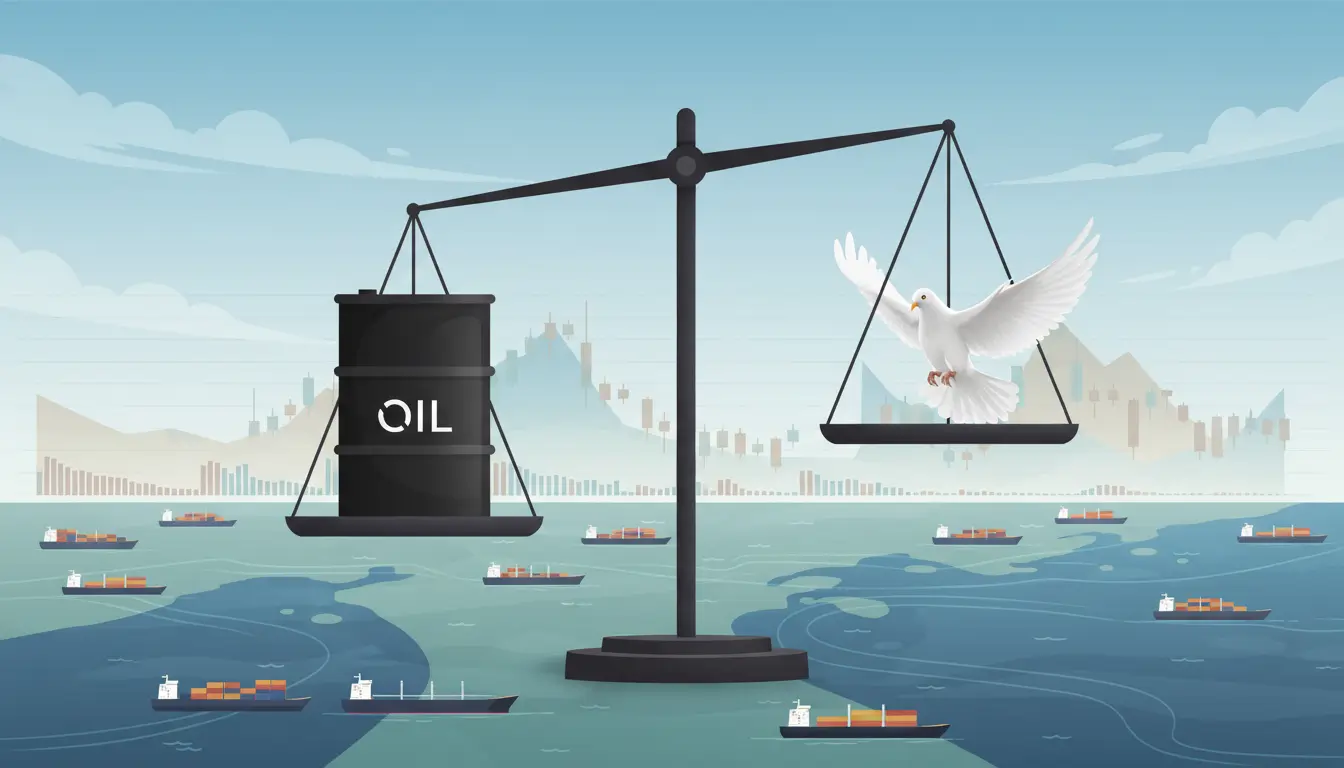
Iran-US Peace Deal Updates: Markets Brace for 60-Day Ceasefire Extension
June 3, 2026 — After months of military escalation and market anxiety, Washington and Tehran appear to be edging toward a preliminary agreement that could extend the current ceasefire by 60 days, reopen the Strait of Hormuz, and launch formal talks on Iran’s nuclear program. Multiple sources confirmed the outlines of the deal to CNBC on May 28, though President Donald Trump has not yet given final approval.
If it moves forward, the agreement would mark the clearest diplomatic breakthrough since hostilities intensified earlier this year. It would also offer investors something markets have been craving for months: a credible path away from disruption in one of the world’s most important energy corridors.
Market Impact: Oil Prices and Energy Sector Volatility
The clearest signal has come from oil. Prices surged above $100 a barrel when Iran’s blockade of the Strait of Hormuz threatened global supplies, then retreated as hopes for de-escalation grew. By May 28, West Texas Intermediate crude was trading at $88.90 a barrel, down more than 10% from its May 18 peak, and roughly 20% below recent highs as traders priced in the possibility of a ceasefire extension and reopened shipping lanes.
That reaction is not surprising. The Strait of Hormuz carries about 20% of the world’s oil supply, along with major liquefied natural gas shipments. Any disruption there quickly ripples through inflation expectations, transport costs, and central bank thinking. Bank of England Governor Andrew Bailey has already pointed to uncertainty tied to the Iran conflict as one factor complicating policy decisions.
Key figures investors are watching:
- WTI crude stood at $88.90 per barrel on May 28, 2026
- Oil prices have fallen more than 10% from their May 18 peak
- Crude is down roughly 20% from recent highs as ceasefire expectations build
- About 20% of global oil supply moves through the Strait of Hormuz
Key Insight: For markets, this is fundamentally an oil story first and a diplomacy story second.
Defense Sector Recalibration and Global Market Reactions
As energy markets recalibrate, defense stocks are also adjusting. The early “buy-on-conflict” trade has already lost momentum. MilitaryTimes reported that the NYSE Arca Defense index fell nearly 8% in March, compared with a 5% decline in the S&P 500, even as fighting continued. In Europe, defense shares dropped 11% during the same month, their steepest fall since the pandemic.
Some major contractors initially benefited from the conflict. Lockheed Martin and Northrop Grumman rose more than 3% and 6%, respectively, during the early stages of the fighting. But those gains have faded as the odds of a diplomatic breakthrough improved.
Elsewhere, the picture is more mixed. MSCI’s global stock index fell 0.59% on May 19, while the STOXX 600 in Europe rose 0.19%, suggesting investors are weighing reduced geopolitical risk against broader inflation and rate concerns. Treasury markets have also been volatile, with 30-year yields hitting their highest levels since 2007 as investors assessed how the Federal Reserve, led by Chair Kevin Warsh, might respond to persistent price pressures.
Investor Implications and Forward-Looking Analysis
For retail investors, the message is straightforward: a durable ceasefire would likely ease pressure on oil, shipping, and inflation-sensitive sectors, while reducing the immediate tailwind for defense shares. Airlines, shippers, and energy-intensive industries could benefit if transit through Hormuz normalizes and fuel costs remain contained. Refiners and petrochemical firms may also gain from lower input costs.
Still, this is not a clean all-clear. The proposed 60-day extension is a holding pattern, not a final settlement. Verification of nuclear commitments, sanctions relief, and the durability of any ceasefire remain unresolved. And after several fragile truces, markets know better than to assume the hard part is over.
That leaves investors in a familiar position: hopeful, but cautious. A peace deal could calm one of the year’s biggest geopolitical risks, yet headline-driven volatility is unlikely to disappear. For now, the most important signals are simple—oil below $90, stable shipping through Hormuz, and steady progress at the negotiating table.