
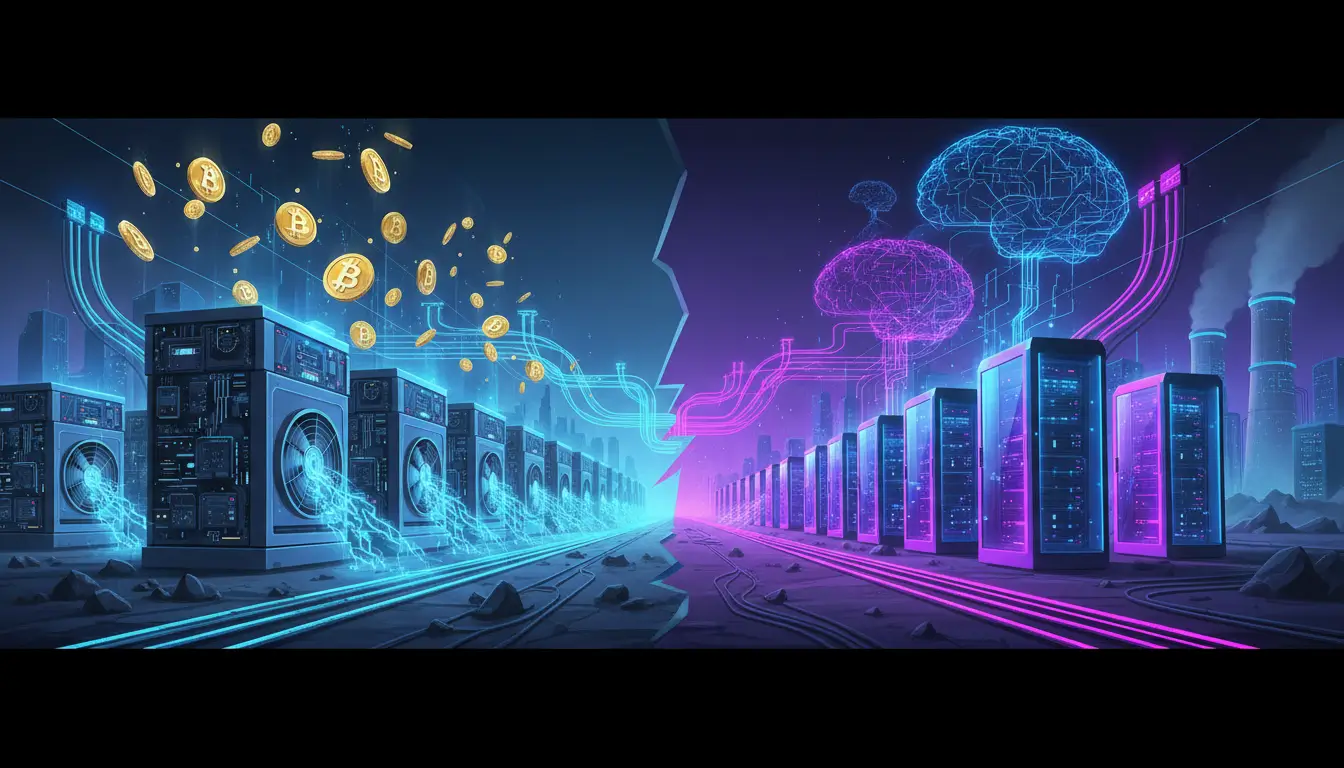
The Great Pivot: Bitcoin Miners' Strategic Shift to AI Data Centers
Introduction
Bitcoin miners built their businesses on one core advantage: access to cheap power and large-scale computing infrastructure. Now, those same assets are being redirected toward a more lucrative customer—artificial intelligence.
As of June 2026, several publicly traded mining companies, including IREN, Core Scientific, and TeraWulf, are pushing aggressively into AI data centers and high-performance computing. The shift marks the industry’s biggest strategic reset since ASICs transformed mining more than a decade ago. What was once a pure play on Bitcoin is becoming, for some operators, a broader bet on digital infrastructure.
The appeal is straightforward. Demand for AI computing capacity is surging, while the economics of Bitcoin mining have become more demanding since the April 2024 halving. At the same time, Bitcoin’s network fundamentals are showing strain: hash rate and mining difficulty are down roughly 8% to 9% from their 2026 highs, according to data highlighted by Fidelity Digital Assets.
The Driving Forces Behind the Transition
Three forces are driving the move.
First, the 2024 halving permanently tightened mining economics by cutting the block subsidy from 6.25 BTC to 3.125 BTC. That sharpened pressure on margins and accelerated consolidation across the sector. For less efficient operators, the path forward in Bitcoin mining alone has narrowed considerably—and it could narrow further ahead of the 2028 halving, when rewards fall again.
Second, AI infrastructure simply pays more. In current market conditions, AI data centers can generate up to eight times more revenue per megawatt than Bitcoin mining. For companies already sitting on power capacity, cooling systems, and industrial-scale facilities, the incentive to repurpose assets is hard to ignore.
Third, the overlap in infrastructure is real. Both businesses depend on reliable electricity, advanced cooling, and data center expertise. Miners that spent heavily during earlier crypto cycles are now finding that those investments may be better monetized in AI than in hash production alone.
Financial Performance and Transition Progress
The numbers show how quickly the pivot is taking shape.
- TeraWulf reported Q1 2026 revenue of $34 million, with more than $21 million coming from AI and high-performance computing leases
- That means roughly 62% of TeraWulf’s revenue now comes from AI-related operations
- TeraWulf’s Q1 2026 net loss widened to $427 million, up from $61.4 million a year earlier
- IREN raised $3 billion in convertible notes in May 2026 to fund its transition
- CoinShares estimates public miners could derive up to 70% of revenue from AI by the end of 2026
Key Insight: The opportunity is large, but so is the cost—miners are trading a volatile crypto business for a capital-intensive infrastructure business with very different risks.**
That tension is already visible. TeraWulf’s results highlight how meaningful AI revenue can become, but also how expensive the transition can be. IREN’s stock rise—from a yearly low of $31.62 to about $52 by mid-2026—shows investor enthusiasm, yet it also reflects expectations that will be difficult to meet without flawless execution.
Impact on Bitcoin Network and Remaining Miners
As large public miners redirect capacity, the Bitcoin network is feeling the effects. The recent decline in hash rate and mining difficulty suggests this is more than a cyclical downturn. It may be the first meaningful hash-rate retreat driven by better alternative uses for mining infrastructure, rather than by regulation or falling Bitcoin prices alone.
For miners staying focused on Bitcoin, however, the shift may create openings. ASIC prices measured in dollars per terahash have fallen to record lows, improving the economics for operators with capital and access to cheap energy. New mining hubs are also emerging in Brazil, Paraguay, Bhutan, and Ethiopia.
Conclusion and Forward Outlook
The industry is splitting into two camps: dedicated Bitcoin miners and former miners reinventing themselves as AI infrastructure providers. That bifurcation could define the sector through 2027 and 2028.
For investors, the challenge is separating credible transitions from marketing narratives. The winners are likely to be companies with strong data center operations, access to financing, and the ability to win AI customers—not just those with legacy mining assets.
Bitcoin mining is not disappearing, but it is changing fast. The same facilities once built to secure the network are now being valued for something else entirely: their power, their land, and their potential to serve the AI boom.