
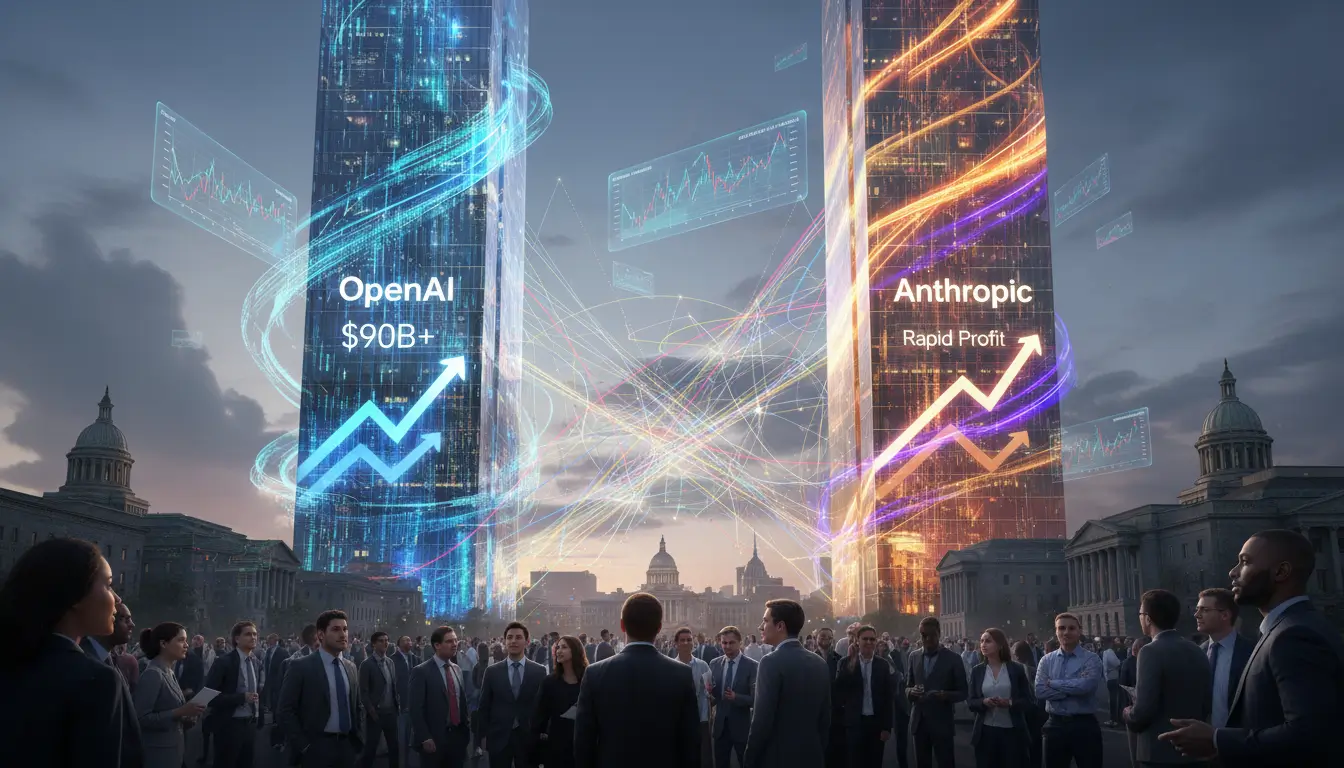
Artificial Intelligence Sector Seismic Shift: OpenAI IPO Announcement, Anthropic Profitability, and a Regulatory Reversal Mark a 2026 Turning Point
The AI race took a sharp turn on May 22, 2026. In a single day, OpenAI moved toward what could become a historic public offering, Anthropic signaled its first profitable quarter, and Washington softened its stance on sweeping federal AI regulation. Taken together, those developments do more than generate headlines. They reshape how investors should think about competition, valuations, and risk in one of the market’s most closely watched sectors.
OpenAI’s $1 Trillion IPO: Big Ambition, Bigger Questions
OpenAI said it plans to file confidentially for an initial public offering within weeks, aiming for a valuation of as much as $1 trillion. If completed, the deal would rank among the largest IPOs ever and could raise roughly $60 billion as soon as late 2026 or early 2027.
The timing is striking. OpenAI remains a revenue powerhouse, but the cost of staying at the frontier of AI is staggering. In the first half of 2026, the company reported $4.3 billion in revenue and $13.5 billion in losses, putting it on pace for roughly $27 billion in annual losses. Its year-end annualized revenue run rate of about $20 billion, disclosed by CFO Sarah Friar, also trails Anthropic’s reported $30 billion pace.
A recent legal win cleared part of the path. On May 18, a federal court rejected Elon Musk’s lawsuit challenging OpenAI’s for-profit structure, removing a major overhang before the planned listing. Still, investors are likely to focus less on legal drama and more on the harder question: whether OpenAI can justify a trillion-dollar valuation while burning cash at this scale.
Anthropic’s Profitability Milestone Raises the Stakes
If OpenAI represents AI’s enormous promise, Anthropic is increasingly becoming the case study in operating momentum. The company told investors it expects its first profitable quarter in Q2 2026, with projected revenue of about $10.9 billion, more than double the prior quarter, and positive operating income.
That milestone caps a remarkable climb. Anthropic’s annualized revenue run rate rose from $87 million in January 2024 to $30 billion by April 2026. Its Claude Code product, launched publicly in mid-2025, reached $1 billion in annualized revenue within six months, making it the fastest-growing software product in the company’s history.
The market is already rewarding that growth. Anthropic completed a $30 billion Series G round in February at a $380 billion post-money valuation, or about 12.7 times its annualized revenue run rate.
- OpenAI is targeting a valuation of up to $1 trillion in its planned IPO
- OpenAI reported $4.3 billion in first-half 2026 revenue and $13.5 billion in losses
- Anthropic expects Q2 2026 revenue of roughly $10.9 billion and positive operating income
- Anthropic reached a $30 billion annualized revenue run rate in April 2026
- Ramp data shows Anthropic leading U.S. enterprise AI adoption
Key Insight: Investors are no longer choosing between growth and profitability in AI—they are being forced to decide which company can deliver both at scale.
Washington Pulls Back, but Uncertainty Remains
The policy backdrop is shifting, too. After earlier backing a more expansive federal framework for AI oversight, the Trump administration appears to be stepping back from aggressive legislation amid industry concerns that tougher rules could weaken U.S. competitiveness.
That does not mean regulation is disappearing. It means the picture is getting messier. While Washington recalibrates, 38 states have adopted or enacted AI measures in 2026, with states including California, Colorado, and South Dakota moving ahead with broad legislation. For companies and investors, that leaves a familiar problem: less federal clarity, more state-level complexity.
What It Means for Investors
For retail investors, the message is straightforward. AI remains a massive opportunity, but the sector is entering a more demanding phase. OpenAI offers scale, brand strength, and potential access to enormous public-market capital. Anthropic offers blistering growth, improving economics, and strengthening enterprise traction.
The next six to 12 months may reveal whether AI’s biggest winners are the companies with the boldest vision, the cleanest path to profit, or simply the deepest pockets. In this market, those are no longer the same thing.